Exploring. Part 3

I’m also an explorer. When I make work, I hope for something outside of me to contribute something. It might sound a bit crazy, but it’s as if I’m only part of the process. I’m on a journey which hasn’t got a destination, so commonly, pieces of my work or series in my work are stops along the way.

Over time, I’ve learnt to trust my hand, so that I no longer throw things out, and I no longer regard things as ‘failed’. They will sit around the studio for months sometimes, until I can find the right place for them. I find time in the studio when I can get out of my head is the most productive. I play music or listen to the radio to facilitate the process of turning off my brain to let it happen.

Monoprint from brain scans, polymer intaglio and relief on tissue paper.
Some years ago, I made a series of prints based on x-rays and scans of the body. X-rays have a kind of bloom on the surface which carries fingerprints and scars from being handled by doctor and patient. They seemed to me to be beautiful – the ghostly image, the passages of darkness and light – and the surface seemed to me to carry a message about what people were feeling about their bodies, their hopes and fears. As I explored these images I noticed a texture of fine striations of darkness and light, which looked like the weave of a fabric. Noticing the way wet ink often transferred to tissue paper laid between newly made prints, I developed a printing process which layered imagery on transparent papers onto the base print. This produced subtle colour shifts, and allowed for a lot of compositional experimentation.

Bone Ikat 7 X-rays, X-ray film, collaged tissue paper.

It was very liberating. I felt no longer tied to the information on the plate. I found I could make a series of different prints from one plate by altering the way I inked up and overlays of transparent paper on the base print. Now, I could print many different images from the same plates. I started to develop a library of plates, which I used in different prints by inking them in different colours and combining them with other plates in different ways. I stopped routinely making editions.

X-ray and brain scan, tissue paper, intaglio and relief polymer.

What do I mean by surface? Part 2 of Artist’s Talk

Well, it’s hard to explain in words, but for me the surface is something one almost feels, rather than sees. It is a visual texture which arouses feelings in me. From my first experience of printmaking, the way the ink could sit IN the paper, or ON the paper engaged me.

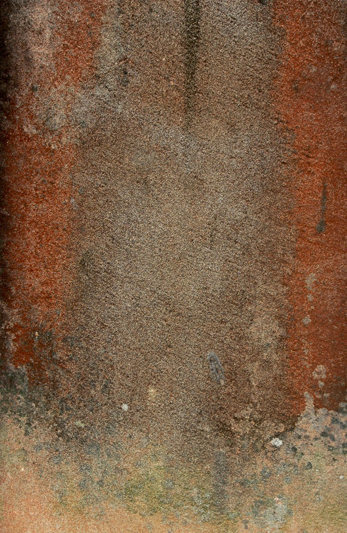
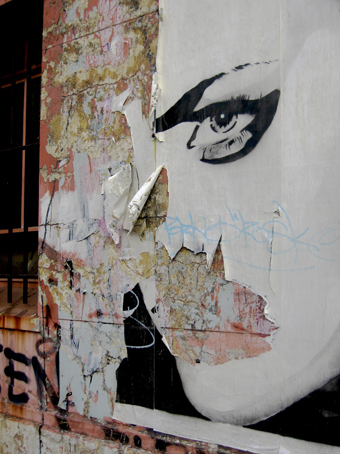
Here are some photographic images which illustrate this feeling for surface. They are mostly of walls. Here are images of age, weathering, distress, wear and tear. The images have been shot in New Zealand, Venice, Prague, Sydney, Tasmania – wherever I have travelled – and to me they have a great sense of place. However, I show people my travel photographs, and they say to me “But where did you actually GO?”

Gravestone, St Thomas Rest Park

When I travel, or at home here, I am often more interested in the walls or the stones beneath my feet than in the buildings, and I’m more interested in the way the people interact with the world they live in, rather than natural forms and surfaces. I feel these surfaces carry the stories of the people who have lived there, that they have changed over time, and you can see in the surface the record of those changes. There might be a nick here, or a scratch there, or a scrawl of graffiti. These walls can be sensitive, fragile and quiet, or they can be vibrant, colourful and energetic.
Melbourne Palimpsest

Manly Gallery Artist’s Talk: Part 1

Yesterday I gave a talk at Manly Gallery to accompany the Leave Nothing but Prints Exhibition. Since I worked quite hard on it, (I find it very difficult to write about my own work) I thought I might publish it here, because it is an explanation of my approach. It was quite long, so I’ll have to publish it in a few parts.I hope you find it worth reading. This first part is illustrated with my photographs.

Why do I make prints?

The things that attracted me to printmaking were things I couldn’t find in painting, though others might. I am immensely attracted to paper, because I am really attracted to the surface of things. I make the joke that I am deeply superficial!

Through printmaking, I work with the paper, layering the images onto it, and trying to make the most of those happy accidents that are the gift of the printmaking gods from time to time. I look for marks I can make to create a seductive surface which will draw the viewer in. I have grown to love  the random, the accidental, the gestural where the nature of the marks I make leaves room for a kind of visual exploration of the surface.

My images are about surface, rather than form, line, colour and so on. I am attempting to evoke a feeling, or a mood, through the surfaces I create.

Leave Nothing but Prints

On Sunday, I visited the Warringah Printmakers Show at Manly Gallery. I had attended the opening on Friday night, but had so much fun I didn’t have time to actually look at the work! And besides, there are artists talks each Sunday afternoon from 3pm.
Nathalie Hartog Gautier talked first about her images which were printed from the picket fence posts that are remnants of the settlement at Hill End, where she did a residency. She had painted the fence posts with the clay pigments she found in the environment there, and printed them relief to water color paper.
Denise Scholz Wulfing spoke about her work – finely executed copper etchings – and demonstrated printing a plate on the small demonstration press.
Sandra Williams discussed her approach to monotypes, and showed some other works from her portfolio, and Jill Carter Hansen, whose work in the exhibition includes an artists book, discussed the manner in which her interest in a wide range of techniques, including animation, photography, filmmaking, printmaking, collage and book construction, leads her to create mixed media works.

It was all very interesting.

Next Sunday at 3pm Trudy Goodwin, Susan Baran, Gwen Harrison and Rebecca Baird will talk about their artworks and the processes that they use. there’s plenty of opportunity to ask questions.

Gallery of Lost Art

The Gallery of Lost Art is an online exhibition that tells the stories of artworks that have disappeared. Destroyed, stolen, discarded, rejected, erased, ephemeral – some of the most significant artworks of the last 100 years have been lost and can no longer be seen.

This virtual year-long exhibition explores the sometimes extraordinary and sometimes banal circumstances behind the loss of major works of art. Archival images, films, interviews, blogs and essays are laid out for visitors to examine, relating to the loss of works by over 40 artists across the twentieth century, including such figures as Marcel Duchamp, Joan Miró, Willem de Kooning, Rachel Whiteread and Tracey Emin.

The Gallery of Lost Art is curated by Tate, designed by digital studio ISO, and produced in partnership with Channel 4, with additional support from The Arts and Humanities Research Council (AHRC).

The Gallery of Lost Art will last for one year before itself being lost. It launched on 2 July 2012 featuring 20 artworks, and a new work is added each week over six months until the exhibition is complete. Beyond these showcased works, the site provides a platform for interaction, discussion and commentary on the subject of lost art as a whole.

Jane Burton, Creative Director, Tate Media, says: “The Gallery of Lost Art is a ghost museum, a place of shadows and traces. It could only ever exist virtually. The challenge was to come up with a way of showcasing these artworks and telling their stories, when, in many cases, poor quality images are all we have left of them. The result is a new way of looking at art: an immersive website in the form of a vast warehouse, where visitors can explore the evidence laid out for them.”

Studio Equipment for sale.

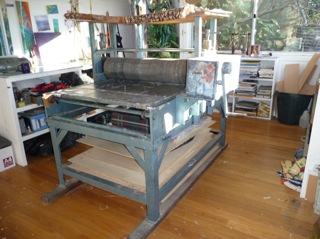
Paul Smith, master printer, is selling his studio equipment, including his beautiful Charles Brand press.

The press, 4 blankets (etching and embossing), rollers (One huge big bertha and several small soft and hard rollers), plan cabinets and other studio equipment are offered at $5,000 (ono).  The press bed size is 1530mm x 915mm.

Sounds like a bargain to me – I really wish I had the room in my studio to accommodate it.

The buyer must pay for its removal, which is not as easy as it might seem, since Paul lives on Scotland Island. However, he has moved it several times with the help of a reliable engineer and he can help with the organisation of transport from Scotland Island to the cargo dock.

Please contact Paul at his website: http://www.estudioeditions.com.au.